Rishta Biodata · Muslim marriage biodata maker

A dignified Muslim biodata for marriage

Create a Muslim marriage biodata online in just 2 minutes. Sect, Maslak, Biradari and Religious Practice fields are already in the form, and there is no horoscope section to delete. Fill in your details, choose a clean design, and download a print-ready PDF, Word, JPG, or PNG file. Free, private, and no sign-up required.

1 Lakh+ biodatas generated

No sign up required 100% private and secure
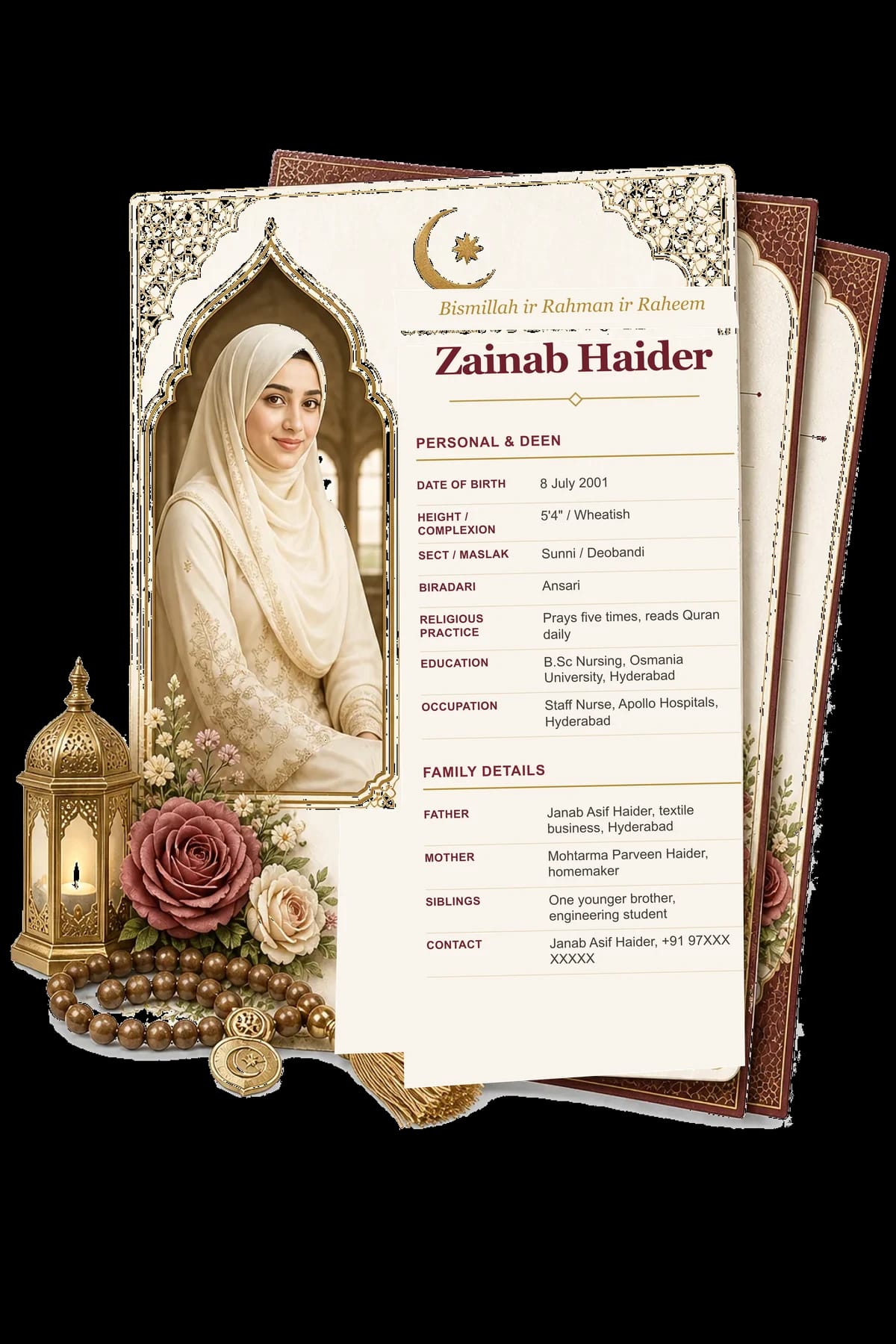
Muslim marriage biodata example with a woman’s portrait, Bismillah header, maroon-and-gold borders, lantern, and prayer beads
100% Private0 details stored on servers
21hand-finished designs
~2 minstart to finished PDF
A4print ready

Choose a design

Muslim Marriage Biodata Templates

These five designs are the ones Muslim families pick most. Each one includes fields for sect, maslak, biradari, and religious practice: fill in your details and download.

Moti Muslim marriage biodata template

Moti

Pearl white with minimal borders. Clean and dignified, works with or without a photo.

Ivory Muslim marriage biodata template

Ivory

Warm ivory background with subtle texture. Modern layout that keeps the focus on your details.

Slate Muslim marriage biodata template

Slate

Dark slate frame on a light background. A thin border that looks formal without being heavy.

Filigree Muslim marriage biodata template

Filigree

Blue and silver ornate border. Traditional enough for elders, clean enough for modern families.

Raat Rani Muslim marriage biodata template

Raat Rani

Deep midnight navy with gold accents. Prints well and stands out on WhatsApp.

View all designs →

the journey

How your biodata reaches the right family

The first thing another family sees about you. Your biodata is the reason they pick up the phone or set it aside.

1

Someone in the family sends it out

A parent, a chacha, a khala, someone who knows the right families. Your biodata goes out on WhatsApp, shared with the people your parents already trust.

2

Both families look into it

Deen, family background, references, all checked on both sides. Istikhara is often prayed before anyone calls. A complete biodata answers most of their questions before they ask.

3

The families meet

Over chai, with most questions already answered. Education, deen, family background, all on the page. The meeting starts warmer and the conversation flows easier.

4

The nikah is fixed, insha'Allah

When both families agree, the nikah date is set. Your biodata did its job: it opened the right doors and kept every detail in one place.

the fields that matter

Muslim Marriage Biodata Format, Explained

Why the deen fields come first

A rishta biodata looks like any other marriage profile at first glance. Name, education, family, contact. But the fields that matter most are different. Instead of horoscope details, you will find sect, maslak, biradari, and religious practice. These are the first things families check, and they shape every conversation that follows.

Keep it to one page. Muslim families expect a short, clear document. The Prophet, peace be upon him, taught that deen and character are what matter in a partner. A good biodata follows that same priority: deen first, then everything else.

Personal & deen details

  • Full name
  • Date of birth and age
  • Height and complexion
  • Sect (Sunni or Shia)
  • Maslak, if your family follows one (Hanafi, Deobandi, Barelvi, Ahle Hadith)
  • Biradari or community (Syed, Sheikh, Pathan, Ansari, Qureshi)
  • Religious practice, in a line or two
  • Education and current occupation
  • Languages known

Family details

  • Father's name and occupation
  • Mother's name and occupation
  • Siblings: number, marriages, where they live
  • Native place and current city
  • Family's religious environment
  • Family values

Contact details

  • Contact person: parent or sibling who answers the phone
  • Phone number with country code if sharing internationally
  • Email address (optional, but useful for NRI families)
  • City and state

A Hindu biodata carries Rashi, Nakshatra, Gotra, and Manglik because kundli matching typically follows. A Muslim biodata replaces all of that with deen details. The rest of the page, personal details, family, contact, stays the same.

the deen section

Writing the Deen Details Right

Families read the deen section first. It tells them what kind of household you come from, and that matters more than most people realise. Here is how to get it right without overthinking it.

Sect comes first, keep it short

Sunni or Shia, one word. That is all most families need. If your family follows a specific maslak, Hanafi, Deobandi, Barelvi, Ahle Hadith, add it the same way. If not, skip it.

Write what you actually do

"Prays five times" works. "Learning to improve" also works. What does not work is writing something you cannot back up in person. Families ask about this at the first meeting, and an honest line always reads better than an inflated one.

Biradari in a single word

Syed, Sheikh, Pathan, Ansari, Qureshi, whatever your family uses. Some families care a lot about this. Others do not. Either way, one word is enough. Spell it the way your family says it.

Keep the Urdu terms

Write in English but keep the Urdu words for deen-related fields. That is how most rishta biodatas work in India, and it is what both generations read without difficulty.

a worked example

Sample Muslim Marriage Biodata

A short, clear biodata that a family can read in under a minute. Deen near the top, work and education next, family before contact.

Bismillah ir Rahman ir Raheem

Zainab Haider

Personal & Deen

Date of Birth8 July 2001
Height / Complexion5'4" / Wheatish
Sect / MaslakSunni / Deobandi
BiradariAnsari
Religious PracticePrays five times, reads Quran daily
EducationB.Sc Nursing, Osmania University, Hyderabad
OccupationStaff Nurse, Apollo Hospitals, Hyderabad

Family Details

FatherJanab Asif Haider, textile business, Hyderabad
MotherMohtarma Parveen Haider, homemaker
SiblingsOne younger brother, engineering student
ContactJanab Asif Haider, +91 97XXX XXXXX

Do

  • Write sect and maslak as one word each, Sunni or Shia, Hanafi or Barelvi
  • Be honest about what you practise today, not what you plan to become
  • Use Janab and Mohtarma when writing your parents' names, it reads well and shows respect
  • Put the city next to the job, for example HR Executive, Wipro, Gurgaon
  • Keep the whole thing to one page, short biodatas get read fully

Avoid

  • Exaggerating how much you pray or practise, families find out at the first meeting
  • Bringing up mahr or nikah conditions
  • Writing exact salary numbers, an income range sounds better and feels less transactional
  • Using a selfie, a clear passport-size photo works better, or skip the photo entirely
  • Copying phrases like religious but modern, write in the language your family actually uses

The first line

Opening the Biodata the Right Way

Many families begin the rishta biodata with Bismillah or a similar line at the top. It is a small touch, but in Muslim households it shows the document is for a serious, blessed purpose. Use the one your family uses.

In the Name of Allah, the Most Gracious, the Most Merciful

The most common opening. Every good thing is begun in the name of Allah, and the rishta biodata is no exception.

Assalamu Alaikum

A simple greeting at the top. Less formal than Bismillah, but warm and immediately signals the document's purpose.

Bismillah ir Rahman ir Raheem

The Arabic transliteration. Works well when the biodata is shared with families who prefer the original script.

No opening

Some families prefer a clean start with just the name and details. Both are normal. Choose what your family is comfortable with.

Community

What Different Communities Look For

The page is the same, but the line families read first changes from community to community.

Sunni

The majority community. Biradaris include Sheikh, Syed, Pathan, Ansari, Qureshi. State your biradari if it matters, otherwise one line for sect is enough.

Shia

A minority community with its own structure. State sect plainly. Maslak may be less relevant, but sect is still one of the first things families ask.

NRI families

Mention your city and country clearly. Add a line about willingness to relocate or preference for a partner in the same region.

Common questions

Muslim Marriage Biodata FAQs

Answers to the questions families ask most often when preparing a Muslim marriage biodata.

What exactly is a Muslim biodata?

A one-page profile that families share when looking for a rishta. It has your personal details, education, work, family background, and deen information like sect, maslak, biradari, and a short note on how you practise. Families read it to decide whether to take the next step.

What goes in place of horoscope fields?

A Muslim biodata carries sect (Sunni or Shia), maslak if your family follows one (Hanafi, Deobandi, Barelvi, Ahle Hadith), biradari or community (Syed, Sheikh, Pathan, Ansari, Qureshi), and a line about religious practice. These are the fields families check first.

Do I need to write my sect and maslak?

If it matters in your family, yes. Elders usually ask about it early. Write each as one word. If your family does not follow a particular maslak, skip that part. One line for sect is enough, and you can remove or rename any field in our maker.

How honest should I be about religious practice?

Be honest. Write what you do today, not what you hope to do. Lines like prays five times, observes hijab, keeps a beard, or practising and learning to improve all read well. Families respect honesty because the truth comes out at the first meeting anyway. One or two lines is enough.

Should I include a photo?

Some families expect one, others do not. If you add a photo, use a clear 3:4 portrait. If you prefer not to, that is fine too. Our templates are designed to look complete either way.

Which design works best for a Muslim biodata?

Pick a clean design without any deity imagery. Our Muslim templates are built for this: Moti, Ivory, and Slate are minimal, Filigree has an ornate blue border, and Raat Rani is a deep navy with gold. You can add Bismillah at the top using the first field.

Should I mention mahr on the biodata?

No. Mahr and nikah terms are decided between families later, in person. The biodata is for introducing yourself.

Can I write the biodata in Urdu?

The maker works in English, but you can type Urdu directly in any field if your browser supports it. Most rishta biodatas in India use English with the Urdu religious terms kept as-is, because both generations read it comfortably and it shares easily on WhatsApp.

Bismillah ir Rahman ir Raheem

Create Your Muslim Marriage Biodata

A clear, honest biodata that families actually read. Free to make, yours to keep.

Create My Rishta Biodata