
Tradition
Navayana (Ambedkarite), Theravada, Mahayana or Vajrayana are the usual starting points. Some families say Tibetan or Himalayan instead of Vajrayana. Use the word your family uses. If you are unsure, ask at home before you fill it in.
Buddhist matrimonial biodata
A Buddhist biodata can keep the focus on education, family and community. Add your tradition or vihara if your family uses one, and add horoscope rows only if your family matches kundlis. Download a print-ready PDF, Word, JPG or PNG in about 2 minutes, including a WhatsApp-ready image.
1 Lakh+ biodatas created
the lines families look for
The standard sections stay the same. Add a short line on tradition and vihara if your family uses them, and add horoscope rows only if your family matches kundlis.
Navayana (Ambedkarite), Theravada, Mahayana or Vajrayana are the usual starting points. Some families say Tibetan or Himalayan instead of Vajrayana. Use the word your family uses. If you are unsure, ask at home before you fill it in.
If your family is associated with a vihara, monastery or community organization, name it in one line. It gives the other family useful context without a phone call.
Education and work are often read early. Write the degree, institution and role in full rather than short labels.
The ancestral village or town, parents' work and siblings' details help families understand your background. Keep it factual and brief.
writing it well
A Buddhist biodata does not need special wording. It needs clear facts, with only the tradition and horoscope rows your family uses.
Place the degree and role near the top, especially if you are writing to families who value education. Write the full name of the college or institution.
Navayana, Theravada, Mahayana and Vajrayana are not interchangeable. Some families say Tibetan or Himalayan instead of Vajrayana. Write the one your family follows, or leave the row out if it is not part of how you introduce yourselves.
Buddhist practice varies. Many Navayana families in Maharashtra do not match kundlis, while some Himalayan families use their own astrological traditions. Add birth details only if your family uses them, and leave the rows out rather than writing N/A.
a filled example
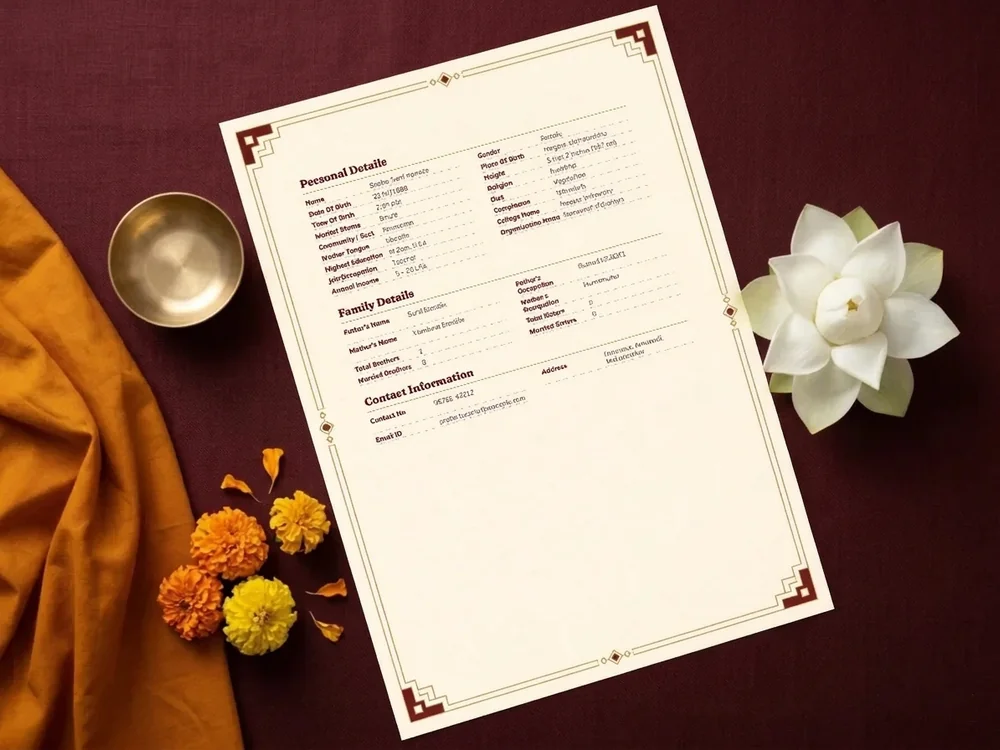
This is the A4 page the biodata maker produces. Download the sample to check the print layout, field spacing and page size before you start.
Example only. Names, places and details are illustrative.
The form starts without horoscope rows. If your family matches kundlis, add them as custom rows. Update the Community / Sect row to name your tradition, add a vihara line as a custom row if your family uses one, and keep the education and work details in full.
The biodata form will load when you reach this section.
Tradition, vihara, horoscope and the details families ask about.
Not as a religious requirement. Buddhist practice varies. Many Navayana families in Maharashtra do not match kundlis, while some Himalayan families use their own astrological traditions. Add birth details only if your family uses them, and leave the rows out rather than writing N/A.
Use the tradition your family follows. Examples are Navayana (Ambedkarite), Theravada, Mahayana or Vajrayana. Some families say Tibetan or Himalayan instead of Vajrayana. If you are unsure, ask at home. A wrong label is worse than an empty optional row.
If your family is associated with a vihara, monastery or community organization, one line is enough. It gives families useful context and can be left out if it is not part of your family life.
Education and work are often read early. Put the degree and role near the top, written in full. It is one of the clearest signals in a short document.
Some families use a short salutation at the top. The form does not add one automatically, but you can add it as a custom line or mention it in the About section.
start here
Fill in your details, preview the page, and download a print-ready PDF, Word, JPG or PNG. Free and private. No sign-up.
Create my Buddhist biodata