Family biodata maker · free, no sign-up

Create your family biodata online, family section first

A family biodata puts your family’s side of the story on one page: parents’ work, siblings, family type, native place, and what the family actually believes in. The form below opens with that section instead of burying it after personal details, and a generator writes the family-introduction paragraph in three tones. Download a print-ready PDF, Word file, or image in about 2 minutes.

1 lakh+ biodatas created

No sign-up needed 100% private: your data stays in your browser
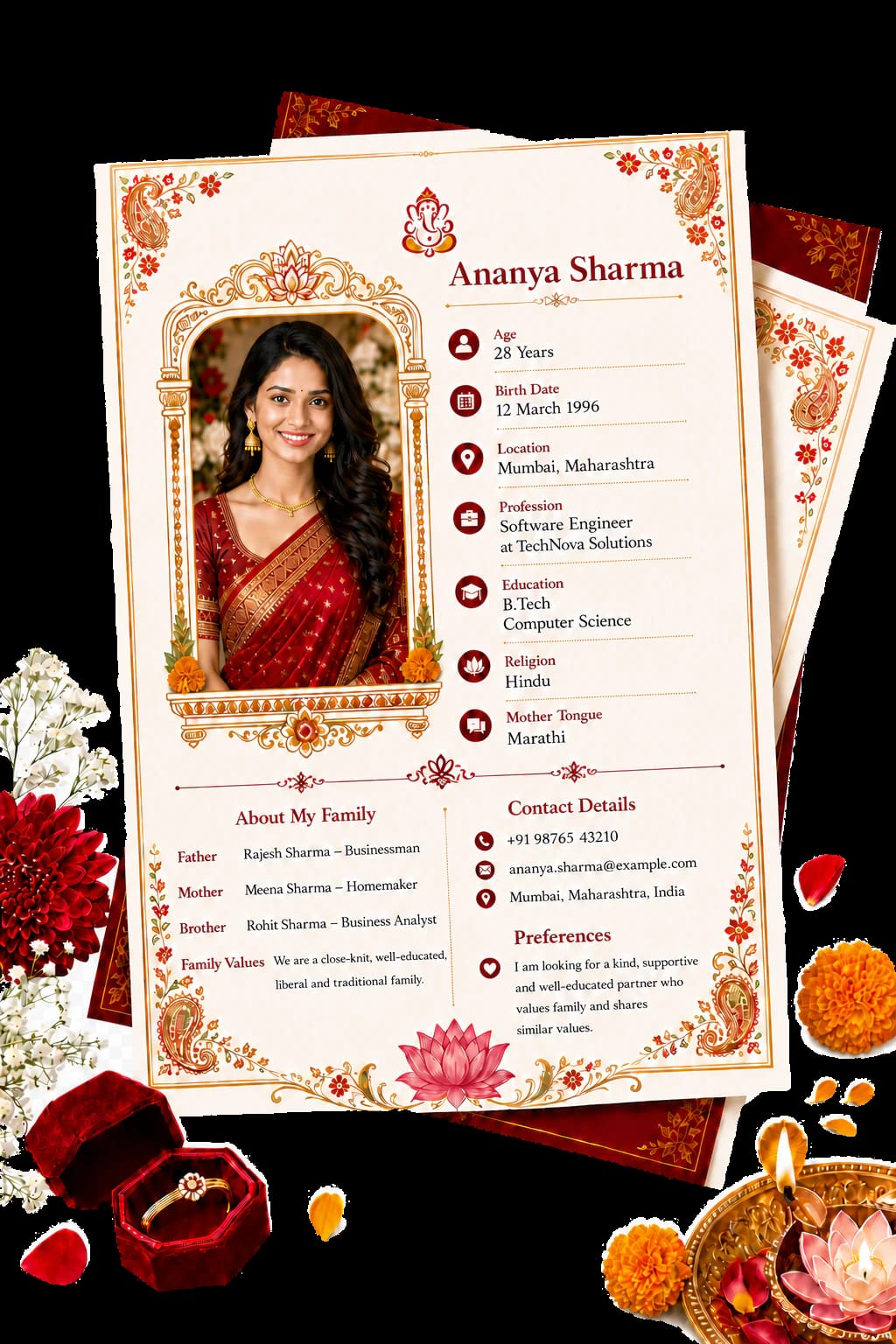
A completed marriage biodata printed on a designed template
50+free designs
4PDF, Word, JPG, PNG
2 minaverage time
0sign-ups

Fill your family biodata now

Same page, no sign-up. The family section comes first here: parents and their occupations, siblings, family type, native place, kul/gotra, family occupation, and a paragraph field for family values. The parent who will answer the phone is also listed first in contacts. Download the print-ready file when you are done.

The biodata form will load when you reach this section.

What it is

Family biodata format for marriage: what goes on the page

One page describing your family’s structure and values, written for the other family to read before a first meeting.

In arranged marriages, the two families are evaluating each other as much as the two people are. A family biodata is the document that answers the family-side questions in advance: who your parents are and what they do, how many siblings you have and where they are settled, whether the family is joint or nuclear, where the family comes from, and what the household actually values.

It is not a separate document from your matrimonial biodata; it is the family section of that one-page biodata, written properly instead of as an afterthought. On this page the form starts with those fields so you can see the section carries its weight: several families read the family paragraph before they read anything else.

Family-intro generator

Write the family-introduction paragraph in three tones

Fill the fields below and get a family-introduction paragraph you can paste straight into the biodata’s family section. Three tones, assembled in your browser; nothing is typed anywhere else, and no AI writes it.

What the family values

Pick as many as fit. The paragraph joins them in one sentence.

Fill at least the family type above; the rest of the fields add detail as you go.

Read it once and edit a word or two so it sounds like your family, not like a form. Two minutes of editing is what makes it sound human.

Field guide

What to write in each family field

The form has the fields; this is how to fill them so the other family gets what they need on first read.

FieldWhat to writeExample
Parents’ occupationsPlain job titles, both parents. This is the first thing families compare. No adjectives needed.Father: government servant · Mother: teacher
SiblingsCount, and whether they are married or settled. Add what each does only if it is short.One brother (married, in Dubai), one sister (studying)
Family typeJoint, nuclear, or extended; if joint, say who all lives in the house.Joint family: parents, my brother’s family, and me
Native placeWhere the family is from, not where you live now. One line.Native to Udaipur, currently living in Pune
Kul / gotraOnly if your community uses these and you want them on the document. Leave it blank otherwise.Kashyap gotra
Family occupationThe family’s trade or business, if there is one the other side would ask about.Family business in textiles, run by my uncles
Family valuesTwo or three sentences: the paragraph the generator above can draft for you.Simple, close-knit family; both daughters were the first in the family to finish college.
Parent contact (primary)Put whichever parent answers the phone first in the contact section; in this page’s form they are listed before your own number.Father’s contact listed first

Every field can be dragged into a different order or deleted with its trash button. The exported document contains only what you leave in the form.

How it differs

Family biodata vs matrimonial biodata

Same one-page document, different centre of gravity. Pick the page that matches what the family asked you for.

Family biodata leads with family

The family section comes first: parents and their occupations, siblings, family type, native place, kul/gotra, family occupation, and the family-values paragraph. Use this when the other family asks for “a family biodata” specifically.

Matrimonial biodata leads with you

Personal details, education, and work come first, with the family section following in the standard order. Use this for the usual arranged-marriage exchange where nobody has asked for a particular format.

Same document underneath

Both use the same 50+ designs and the same exports: PDF, Word, JPG, PNG. Whichever page you start on, the file that comes out is the same format.

Open the matrimonial biodata maker →

Your family details are not stored separately; start on whichever page fits and the document you download is interchangeable.

FAQ

Family biodata: common questions

What people ask before filling the form on this page.

What is a family biodata?

A one-page document describing your family’s structure and values for an arranged-marriage conversation: parents and their occupations, siblings, family type, native place, kul/gotra if your community uses it, family occupation, and a short family-values paragraph. It is the family section of a matrimonial biodata, written out properly rather than left as a few bullet points.

Is a family biodata the same as a matrimonial biodata?

It is the same one-page format with a different emphasis. A matrimonial biodata leads with your personal details, education, and work; a family biodata opens with the family section and gives the family-values paragraph room. Both export to the same PDF, Word, JPG, or PNG from the same set of designs.

What should the family section include?

Parents and what they do, siblings and where they are settled, whether the family is joint or nuclear, the family’s native place, kul/gotra if you use those terms, any family occupation, and two or three sentences on what the household values. That is exactly what the form on this page asks for, in that order.

How do I write the family-introduction paragraph?

Use the generator above: fill in family type, native place, parents’ occupations, siblings, and pick the values that fit. It assembles three versions (traditional, modern, and short) in your browser, and you paste whichever one sounds closest to your family. Then edit a word or two so it reads like you wrote it.

Should I include kul and gotra in my family biodata?

Only if your community uses those terms and you want them on the document. Both are common in North Indian biodatas and less so elsewhere; if the field does not apply to you, leave it blank or delete the row; an empty field does not print.

Who should be the primary contact on a family biodata?

Whichever parent answers the phone first, if a parent is writing or coordinating. On this page’s form, parent contact numbers are listed before your own number for that reason. If you are handling the conversation yourself, put yours first instead.

Do I need to say whether the family is joint or nuclear?

Yes: it is one of the first things the other family will want to know, and stating it plainly saves an awkward question later. Say joint and who lives in the house, or nuclear and who is nearby.

Can I delete fields I do not want to answer?

Yes. Every row has a delete button, and fields can be dragged into a different order. The export only prints what is left; nothing empty is carried into the document.

What format should I download?

PDF for printing and forwarding on WhatsApp, Word if you want to keep editing the text, JPG or PNG for pasting into a message. All four are free and none of them require an account.

Is my family’s information stored anywhere?

No. Everything you type stays in this browser; nothing is sent to a server unless you download or share the file yourself, and clearing your browser data clears the form. The generator runs in your browser too.

shaadi ki taiyari

Your family, on one page

Fill the form, pick a design, download the file. Two minutes, no sign-up, nothing stored on a server.

Start filling the form