
Got and community
Got is the family clan name. Write it only if your family uses it, and add the mother's side if that is how your family introduces itself. Community lines such as Jat, Khatri, Arora or Ramgarhia are optional.
Sikh matrimonial biodata
A Sikh biodata should make the important things easy to find, including family, education, your family's got (clan name), and how you practice your faith. Start with Sikh-friendly fields, keep the Khanda if you wish, and download a print-ready PDF, Word, JPG or PNG in about 2 minutes, including a WhatsApp-ready image.
1 Lakh+ biodatas created
the lines families look for
Most of the page is the same as any good biodata. A few lines carry the Sikh context, and every one of them is optional.
Got is the family clan name. Write it only if your family uses it, and add the mother's side if that is how your family introduces itself. Community lines such as Jat, Khatri, Arora or Ramgarhia are optional.
If your family attends a gurdwara, name it. If your family uses the labels Amritdhari, Keshdhari or Sehajdhari, add the one that fits. Describe your practice as it is.
Vegetarian, eggetarian or non-vegetarian is enough. Add alcohol or smoking only if you want to state it. A short honest line prevents assumptions.
The pind or ancestral village tells families where your family is from. If close relatives live in Canada, the UK or Australia, one factual line is often useful.
writing it well
A biodata is read quickly. One clear line does more work than a paragraph of adjectives.
Some families use the full name with a surname, and others prefer Singh or Kaur alone. Use the form that matches your official documents and the way your family introduces you.
Write Keshdhari and note that you attend gurdwara most Sundays. That is more useful than a vague line about being deeply religious. It answers the question without turning the page into a self-assessment.
If your family does not use got, horoscope or caste, remove the row instead of writing N/A. A page with empty rows looks like it was made for someone else.
a filled example
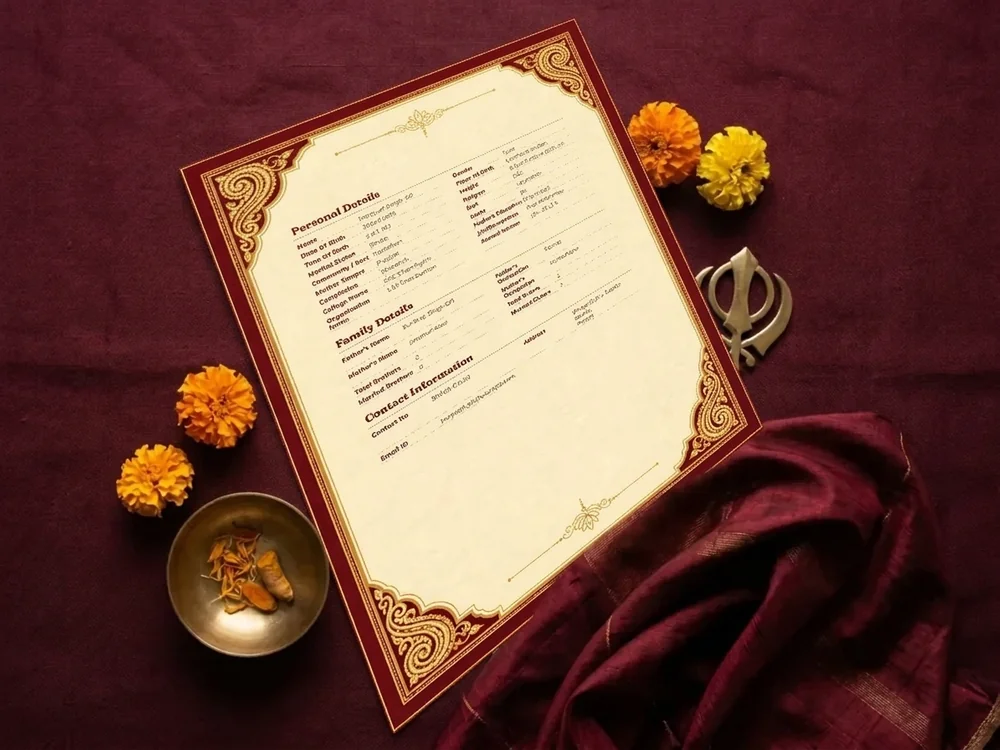
This is the A4 page the biodata maker produces. Download the sample to check the print layout, field spacing and page size before you start.
Example only. Names, places and details are illustrative.
The form starts without horoscope rows, so you are not asked for rashi, nakshatra or manglik details. If your family uses them, add them as custom rows. Update the Community / Sect and Diet rows that are already there, add a got, gurdwara or practice line as a custom row, and remove anything that does not fit.
The biodata form will load when you reach this section.
What to include, what to leave optional and how the files work.
Not as a religious requirement. Sikh teaching discourages astrology, so many families leave kundli rows out, while some Punjabi families still use them culturally. Add rashi, nakshatra and manglik only if your family follows those customs. The form does not add them by default on this page.
Got is the family clan name. Many Sikh families include it, and some also add the mother's side. If your family does not use it, leave it out. A missing optional row is better than a row filled with N/A.
Use one plain line, for example Keshdhari with kesh and a turban, or Amritdhari since 2019. Write what is true now. If you are planning to take amrit, that can wait for a conversation.
Yes. The Khanda appears first in the symbol picker on this page. You can change or remove it at any time, and the preview updates with your choice.
A short line about close relatives abroad is common and often useful. Keep it factual. For example, write 1 elder sister, married, Canada. There is no need to list the whole family tree.
start here
Fill in your details, preview the page, and download a print-ready PDF, Word, JPG or PNG. Free and private. No sign-up.
Create my Sikh biodata