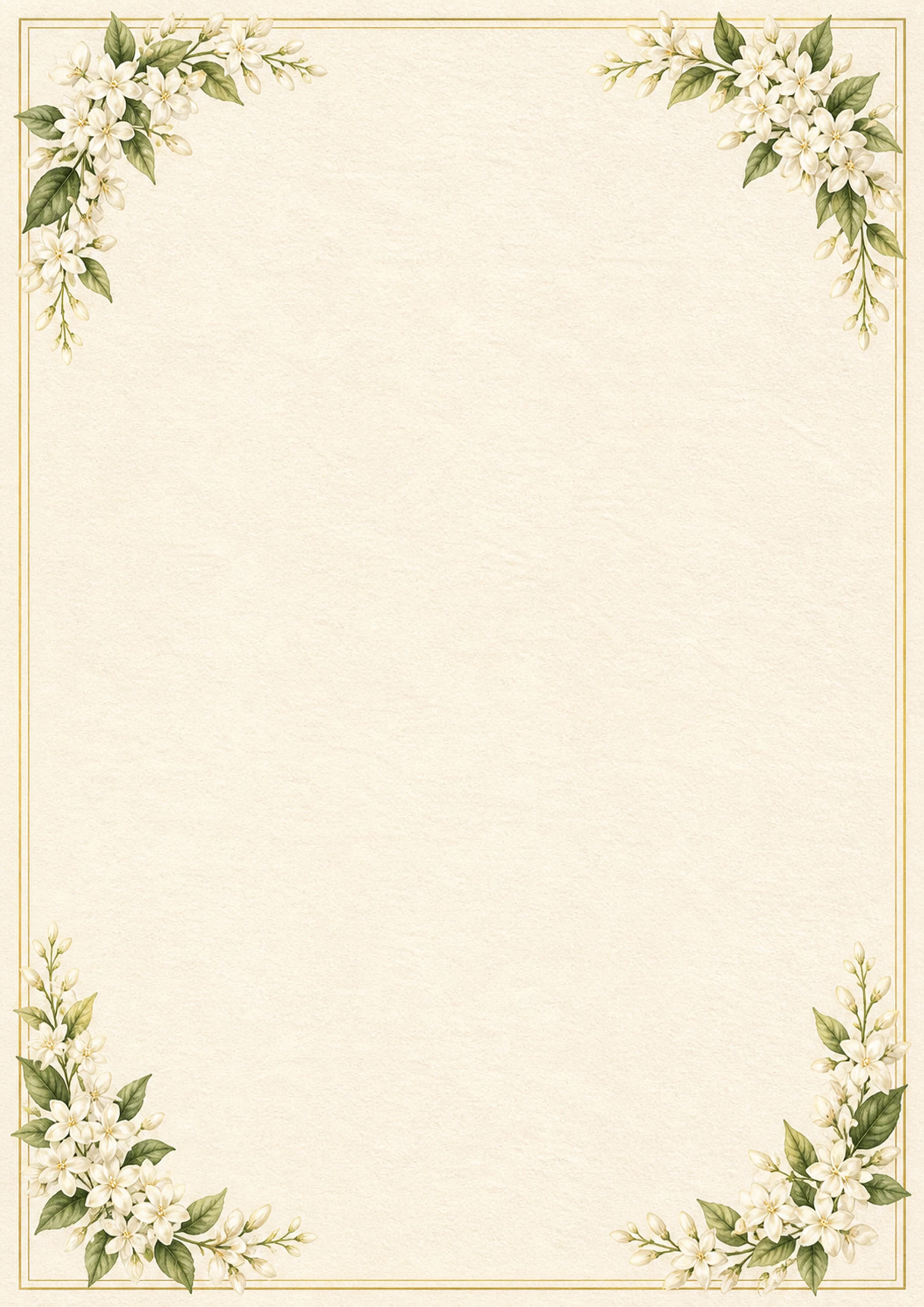
Chandan
Warm sandalwood tones with a classic Ganesha border. The one most families recognise.
॥ शुभ विवाह ॥ · Hindu marriage biodata maker
Create a Hindu marriage biodata online in just 2 minutes. The Rashi, Nakshatra, Gotra and Manglik fields are already in the form, arranged the way elders read them. Fill in your details, choose a traditional design, and download a print-ready PDF, Word, JPG, or PNG file. Free, private, and no sign-up required.
1 Lakh+ biodatas generated
The form is on this page — Rashi, Nakshatra, Gotra and Manglik fields are already arranged the way elders read them. Add your details, pick a traditional design, and download a print-ready file. Free, private, no sign-up.
The biodata form will load when you reach this section.
Choose a design
Start with these five Hindu designs. Each leaves room for Rashi, Nakshatra, Gotra, and Manglik details, so you can fill in the fields and download a finished page.
Warm sandalwood tones with a classic Ganesha border. The one most families recognise.
Deep vermillion header with gold filigree, for a traditional first impression.
Orange and gold floral motifs that feel festive without being busy.
The process
In most Hindu families the biodata is the first formal step. Here is how it moves from a PDF on WhatsApp to a roka, the formal engagement ceremony.
Parents, relatives, or a matchmaker share it on WhatsApp. First impressions matter: families notice the layout and the first fields right away.
A panditji uses the date, time, and place of birth from the biodata to check Rashi, Nakshatra, and Manglik compatibility. Accurate birth details save time at this stage.
Over chai, the biodata has already answered the basics. The meeting moves faster because horoscope, education, and family background are on the page.
When both sides agree, the roka (formal engagement) or sagai is set. The biodata served its purpose. It opened the conversation and kept every detail in one place.
The fields
A Hindu biodata leads with the horoscope section: Rashi, Nakshatra, Gotra, and Manglik status. These fields come first because a panditji needs them for kundli milan. That is what sets it apart from a general marriage biodata, and the horoscope section is not optional. In the Hindu tradition, vivah is one of the sixteen sanskars, a turning point for two families, not just two people. The biodata is the first formal gesture of that joining, which is why even a simple one is written with care.
Horoscope section
Keep it factual and brief. The full janam patrika comes later, when families have met and are ready to compare charts. Here is what belongs on the page.
Write the exact time and city, not just the date. A panditji cannot cast a chart without the birth time. If the time is approximate, say so. "Early morning, approx 6 AM" is better than nothing. Most families do not need the padam or pada number on the biodata.
Write one of three: Manglik, Non Manglik, or Anshik Manglik. Avoid vague phrases like "slightly Manglik" or "Mars effect is mild." Plain wording helps families decide quickly.
One word. Many Hindu communities avoid same-gotra marriages, so this field is checked early. Spell it the way your family uses it. If there are regional variations, the panditji will know.
Compatibility
For Kundli Milan, start with accurate birth details. In North India, Ashtakoota matching compares eight kootas and scores 36 gunas in total. Families often use 18 or more as a general reference point. The table below explains what each koota covers, so you can follow the questions your family may ask.
| Koota | What it weighs | Gunas |
|---|---|---|
| Varna | Temperament and nature of work | 1 |
| Vashya | Mutual influence and adaptability | 2 |
| Tara | Birth star compatibility and wellbeing | 3 |
| Yoni | Instinct and physical compatibility | 4 |
| Graha Maitri | Mental and intellectual match | 5 |
| Gana | Disposition: deva, manushya or rakshasa | 6 |
| Bhakoot | Emotional bond and family welfare | 7 |
| Nadi | Health and progeny, weighted heaviest | 8 |
| Total | 36 |
South Indian families may use the 10 porutham system instead of the 36-gun Ashtakoot method. The biodata fields stay the same: birth time, Rashi, Nakshatra, and Gotra. Only the matching method changes.
See it in action
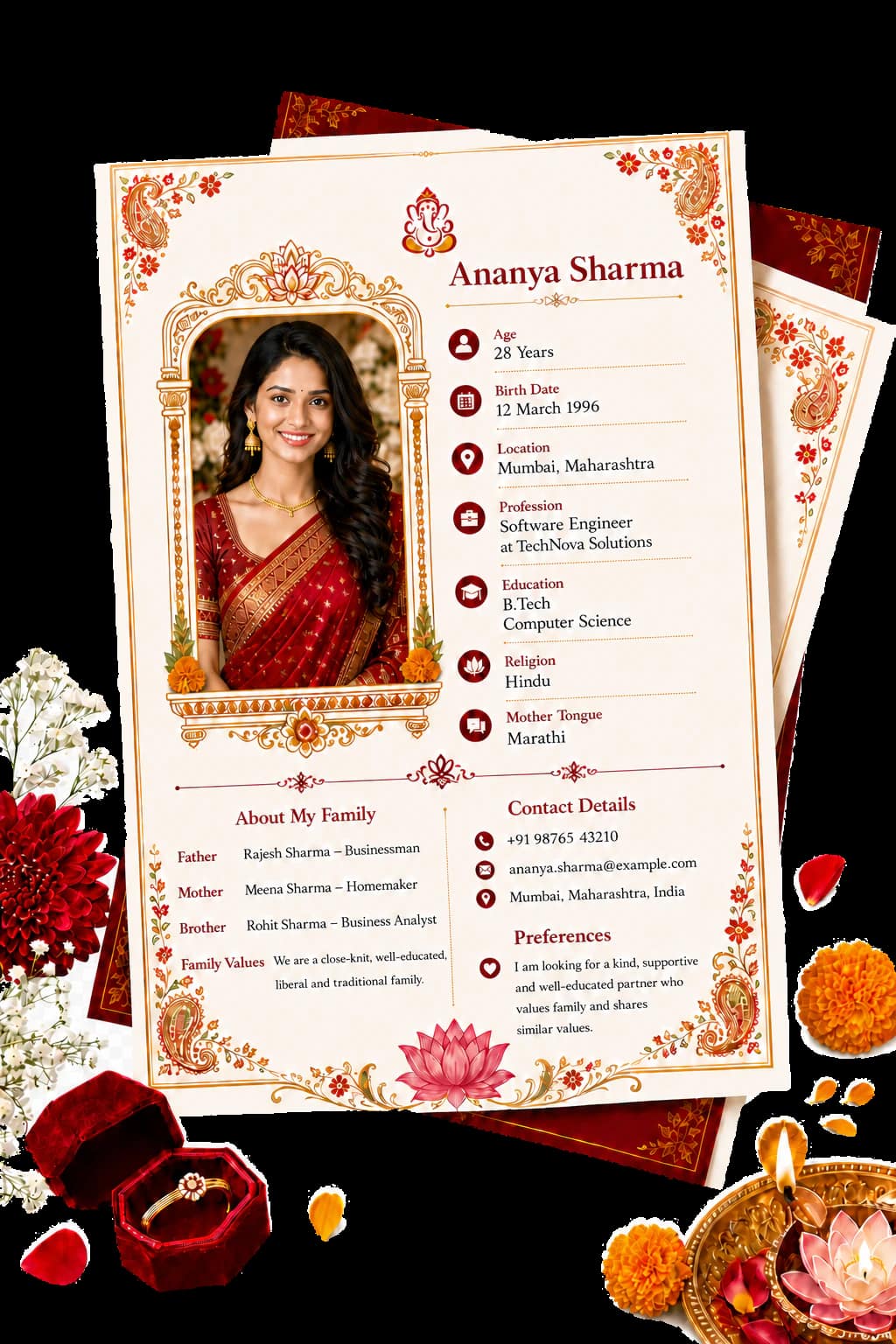
Here is how a finished Hindu biodata reads. Replace the placeholder details with your own.
Across India
Every region has its own word for the same one-page document. The fields stay the same, only the name changes.
शादी का बायोडाटा
Shaadi ka biodata
Hindi belt
लग्न बायोडाटा
Lagna biodata
Maharashtra
જીવનસાથી બાયોડેટા
Jeevansathi biodata
Gujarat
জীবনবৃত্তান্ত
Jeebanvrittant
Bengal
పెళ్లి బయోడేటా
Pelli biodata
Telugu states
ஜாதகம்
Jathagam
Tamil Nadu
The first line
A shubh line at the top signals this biodata is meant for something serious. Think of it like a wedding card opening. Pick the one your family uses at home, or skip it altogether.
॥ श्री गणेशाय नमः ॥
The default choice. Ganesha is the first name called in almost every Hindu ritual, and this biodata follows the same order.
ॐ
One symbol. No deity name attached, so every tradition is fine with it.
जय श्री कृष्ण
The Vaishnav pick. Very common in Gujarat and Rajasthan, where families lean toward Krishna.
जय माता दी
Used by Devi-worshipping families across North India.
Community
Every Hindu biodata carries the same fields. But families read them in a different order depending on their community. Here is what to watch for, and if anything feels unclear, the eldest person in the house will know the answer.
The first thing most Brahmin families look for is the gotra. Some also include pravara, the lineage verse that traces back through generations. Southern Brahmin families tend to focus on jathagam and porutham compatibility, which serve the same purpose as Ashtakoota matching in the North.
Maratha families often include kul, the family clan name, alongside gotra. Some also list devak, the sacred symbol associated with the family. If devak is part of your tradition, mention it as a separate line in your biodata.
In Marwari and Bania families, gotra compatibility is taken seriously by both sides. Diet is also noted carefully. Phrases like 'pure vegetarian, no onion and garlic' carry real weight in these biodatas and help families quickly assess compatibility.
Rajput families typically lead with vansh, the lineage, and kul, the clan. Many specify whether they are Suryavanshi or Chandravanshi. Use the exact terms your family uses when describing your lineage.
Common questions
Answers to the questions families ask most often when preparing a Hindu marriage biodata.
The horoscope section. A standard biodata skips it entirely, but a Hindu one cannot, because kundli matching follows. The rest is the same: personal details, education, family background, and contact information.
Write it. Families check this field early, and leaving it blank usually means a phone call asking for it. One of three: Manglik, Non Manglik, or Anshik Manglik. If your family skips kundli matching, leave it empty.
The panditji needs them for kundli milan. Rashi (moon sign) and Nakshatra (birth star) feed into the horoscope matching. Gotra tells families if both sides share the same lineage, and many communities avoid same-gotra marriages. All three are already in our form.
Keep it separate. The biodata only needs the summary: birth date, time, place, Rashi, Nakshatra, Gotra, and Manglik status. The full janam patrika travels on its own, usually after families have met and the panditji asks for it. Crowding planetary charts onto a one-page biodata makes it harder to read.
Skip it if you want. Many families add a Ganesha image or a line like 'Shri Ganeshaya Namah' at the top because it marks the occasion. Others leave it blank and pick a simpler template. Either way works.
Traditional or clean, that is the choice. Chandan and Marigold carry Ganesha motifs, Sindoor goes deep red, and Toran and Mandap use an arch-and-garland style. Every template includes the horoscope fields, and you can reorder or remove any field.
The panditji scores it out of 36. North Indian families use the Ashtakoota system, which compares eight kootas, and 18 or more is generally considered a good match. South Indian families often use the 10 porutham system instead. Your biodata provides the birth details; the panditji does the rest.
Every region calls it something different: shaadi ka biodata in Hindi, lagna biodata in Maharashtra, biyer biodata in Bengali, pelli biodata in Telugu, and jathagam in Tamil. The name changes, the fields do not.
shubh kaarya
Fill in your details once, preview every Hindu design, and download a print-ready PDF. Free to make, and yours to keep.
Create My Hindu Biodata