
Marital status
“Divorced in 2021; on good terms with my family.”
The year makes it factual. Delete the second half if it does not fit. The first half does the work on its own.
Second marriage biodata maker · free, no sign-up
A second-marriage biodata answers the questions a family will actually ask: what is your marital status now, do you have children, and what are you looking for next. Fill the form below and the fields are already arranged in that order: marital status first, children and previous marriage right after it. Download a print-ready PDF, Word file, or image in about 2 minutes. Nothing leaves your browser until you share it.
1 lakh+ biodatas created
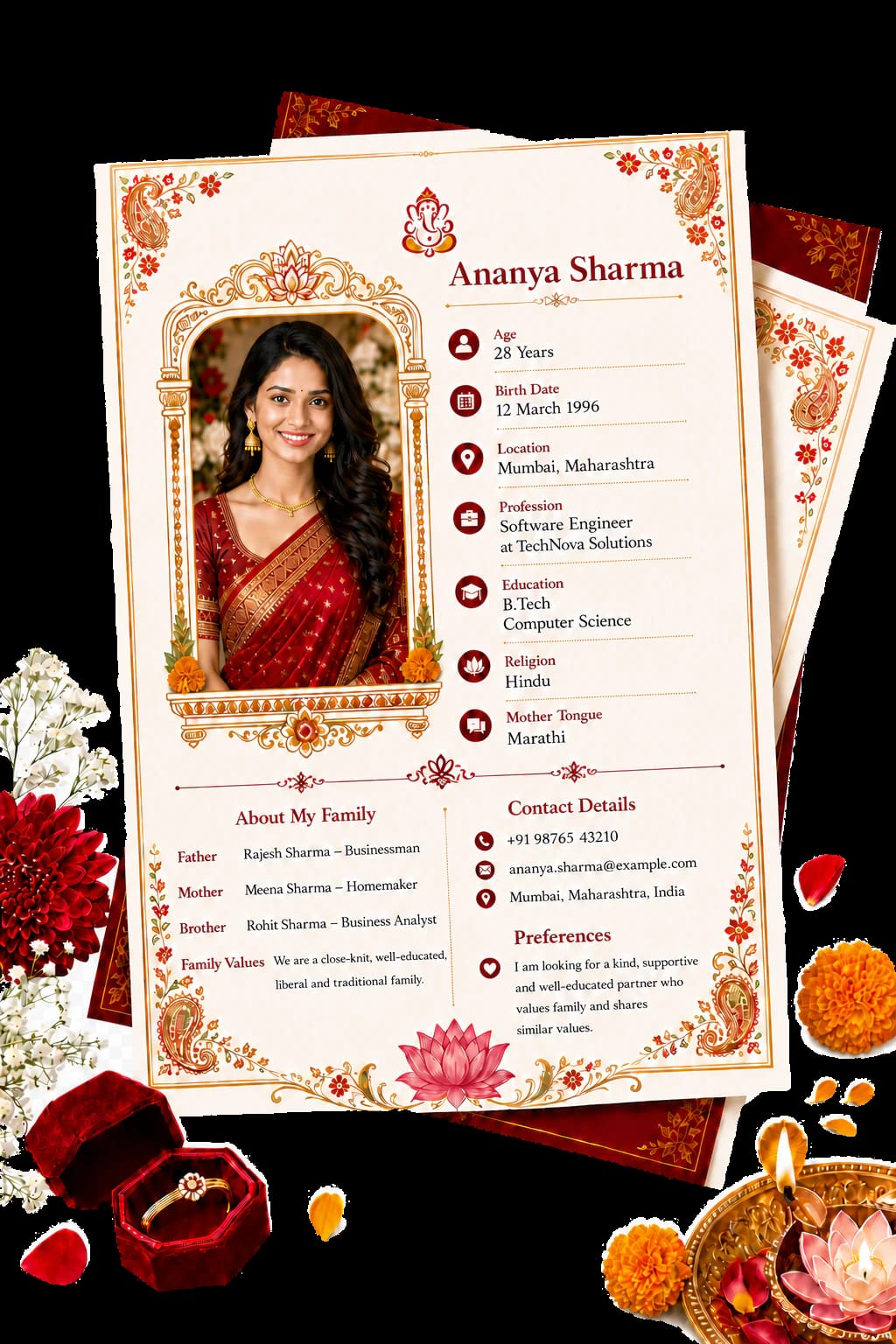
Same page, no sign-up. The marital status options are built for this page (divorced, widowed, separated, annulled, or awaiting divorce), and the children, previous-marriage, and open-to fields sit right underneath. In Open To, one plain line about what you would accept next is enough: for example, remarriage, a partner with children, happy to relocate. Answer, choose a design, download the print-ready file. Nothing is sent anywhere until you choose to share it.
The biodata form will load when you reach this section.
What it is
One page, plainly written, that lets a family understand your situation before the first conversation.
A second-marriage biodata is the same one-page document used in arranged marriages (name, age, education, work, family), with the fields that matter the second time given room near the top: your current marital status, the year it changed, whether you have children and who they live with, and what you are open to next.
The document does not argue your case and does not need to. Stated factually, these details read as straightforward rather than defensive, and they save both families the awkwardness of asking later. This is why the form on this page opens with those fields instead of hiding them below education and income.
Recommended order
The order below puts the questions a family asks first, then returns to the standard biodata flow. Everything after the third section is the same as any other biodata.
The form above already starts in this order for this page. You can drag any field to move it, or delete a row you do not want.
Mention vs skip
The most useful rule for a second-marriage biodata: state the facts that change how the conversation starts, and leave everything else for the conversation itself.
| Topic | Mention it like this | Leave out |
|---|---|---|
| Marital status | The current status and the year, as a plain fact: "Divorced, 2021." | No euphemisms, no vague wording. Readers distrust both, and the status has to come out eventually. |
| Children | Count and who they live with: "Two children, living with their mother." | Custody arrangements, maintenance amounts, and any disagreement about them. |
| Previous marriage | One optional line confirming it happened: "Married once before." | Why it ended: no reasons, no fault, no timeline of events. |
| Awaiting divorce | The status itself: "Awaiting divorce." | Case details or dates. If asked, "check with family and a lawyer before stating a date" is the honest answer; this page does not give legal advice. |
| Children's photos | Nothing: keep children out of the document entirely. | Never use a child's photo, or any photo with an ex-spouse in it. |
| Preferences | What you are open to, in two or three lines. | Nothing that reads as ruling a caste or community out; state what you want, not who is beneath it. |
| Feelings about it all | Nothing. The document is facts; warmth comes across in person. | Apologies, over-explanations, or reassurances. The document does not need them. |
Widowed and divorced carry different weight with different families; state whichever applies in the same factual tone. Neither needs softening, and neither is anyone else's business to question.
Wording bank
Borrow a line if the field is hard to start. Change the words so they sound like you; one or two edits is usually enough.
Marital status
“Divorced in 2021; on good terms with my family.”
The year makes it factual. Delete the second half if it does not fit. The first half does the work on its own.
Widowed
“Widowed in 2019. I have rebuilt my routine and am ready to look ahead.”
Widowed and divorced are different situations. Do not use lines written for one when you are the other.
Children
“Two children, living with their mother. I am involved and supportive.”
"Living with" answers the question families ask first, without going near custody details.
Previous marriage, one line
“Married once before; details are easy to share in person.”
Confirms the fact, offers the rest privately. This is the whole mention.
Awaiting divorce
“Awaiting divorce; the process is underway and I would rather discuss the rest in person.”
No dates or case detail. Before putting a date on paper, check with family and a lawyer; this is a biodata page, not legal advice.
Written by a parent (third person)
“Our daughter was married in 2018 and the marriage ended in 2021. She teaches at a primary school and lives with us in Pune.”
When a parent writes the biodata, third person keeps the tone warm and factual; most family-written biodatas read this way.
Copy the structure, not the life. These lines work because they are short and factual; a line that is not true of you will read wrong even if it sounds good.
Children
State what a family needs to know to plan a conversation, and stop there.
The two facts worth putting on the page are the number of children and who they live with. Both are normal questions at the first meeting, and putting them in the biodata means nobody has to work up to asking. Use plain wording: "Three children, living with their mother."
What does not belong on the page is the arrangement around those children: custody orders, maintenance, visitation, or any disagreement attached to them. Those are private matters for a conversation between families, not details on a document that will be forwarded to relatives and printed in three copies.
If you have children living with you, say so in the same factual tone. For plenty of families that is a positive, and stating it early simply finds the right ones sooner.
Keep children out of the document entirely when it comes to photographs; the section below explains why.
Photographs
One photograph of the person the biodata is about. That is the whole rule.
The photo you add stays in your browser and only reaches the file you download.
Privacy
A second-marriage biodata travels further than a first one; relatives forward it, and screenshots outlive the group it was sent in.
FAQ
What people ask before filling the form.
Yes: state the current status and the year as a plain fact. Families find out either way, and a biodata that states it directly reads as honest. Euphemisms and vague wording do the opposite of what you want.
Mention the status ("divorced, 2021") and not the reasons. The status is a fact a family needs before meeting; the reasons are private and belong in a conversation, not on a page that gets forwarded to relatives.
Use "widowed" with the year, in the same factual tone as any other status. Widowed is not the same situation as divorced and the wording should not borrow from it. One line of fact is enough, and the rest of the biodata is identical to any other.
Include the number of children and who they live with, as one line each. Leave out custody arrangements, maintenance details, and children's photographs. Families ask about children early, so answering on the page reads as straightforward rather than as oversharing.
Write the status that is true ("separated" or "awaiting divorce") without case details or dates. If you are unsure what to state, check with family and a lawyer before putting a date on paper; a biodata page cannot give legal advice.
No. One optional line confirming the earlier marriage is plenty; why it ended is not on the document. Everyone who reads the biodata will have the chance to ask in person, where the answer can be a conversation rather than a paragraph.
The structure is the same one page: name, age, education, work, family, preferences. The difference is order: status, children, and one line on the previous marriage go near the top so the family reading it starts from the right place.
Either. If a parent writes it, third person ("our daughter…") is the normal register and keeps the tone warm and factual. The wording bank above has a ready-made example of that line.
Yes. Every row in the form can be deleted with its trash button, and fields can be dragged into a different order. The exported document only contains what you left in the form.
PDF for printing and WhatsApp forwards, Word if you want to keep editing the text later, JPG or PNG for pasting into a message. All four are free and all four download without an account.
No. Everything you type stays in this browser. Nothing is sent to a server unless you download or share the file yourself, and clearing your browser data clears the form.
shaadi ki taiyari
Fill the form, pick a design, download the file. Two minutes, no sign-up, nothing stored on a server.
Start filling the form