
Quick answer
Marriage Biodata Samples: 6 Practical Examples
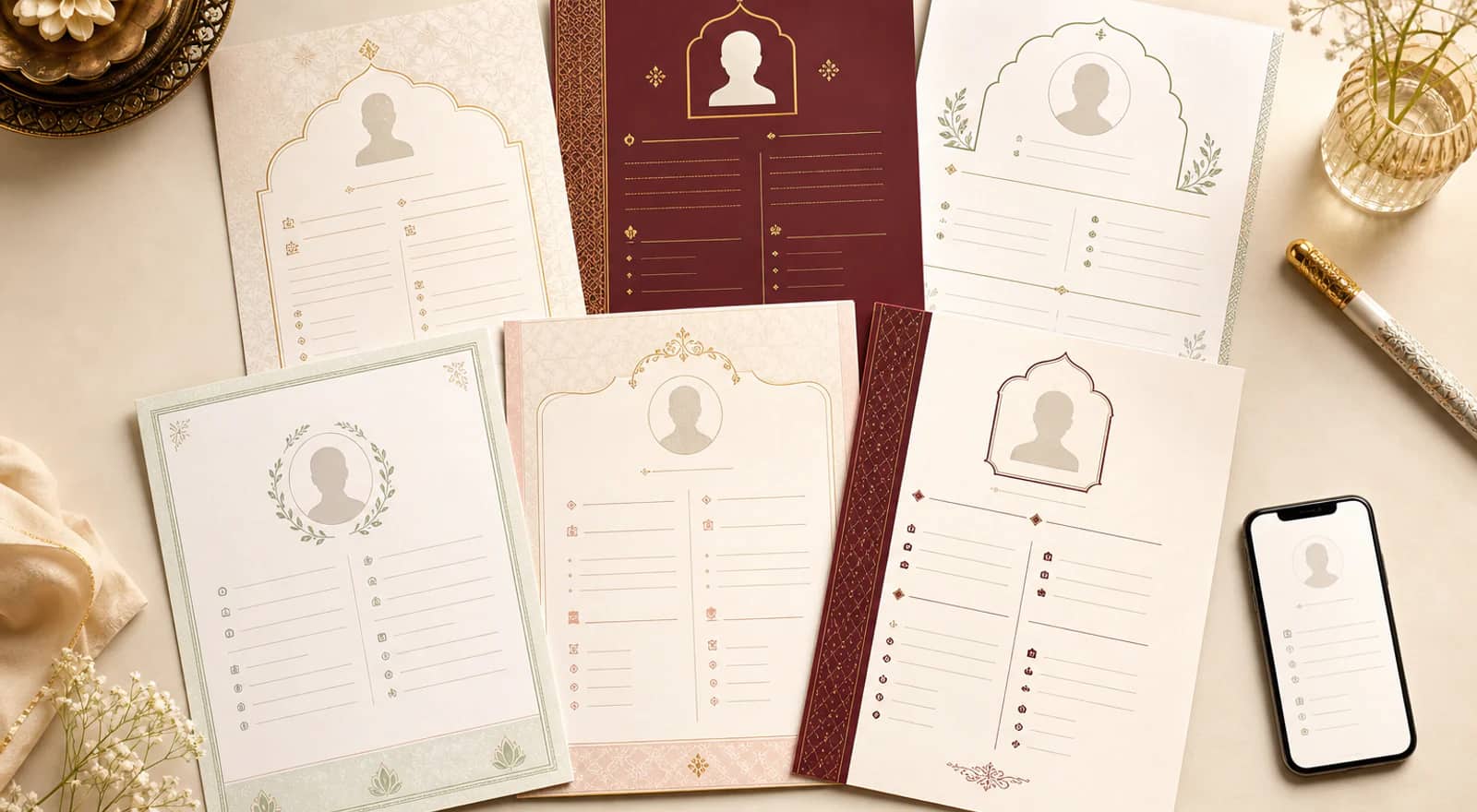
A useful marriage biodata sample is short, specific, and easy for both families to scan. Start with personal details, education and work, then add family information, any relevant community or kundli fields, a brief introduction, expectations, and a contact. Borrow the structure below, but write every personal detail in your own words.
A biodata should sound like a real home
A marriage biodata rarely travels straight from one person to another. A parent may read it first, then an aunt, uncle, family friend, or mediator. By the time it reaches the other family, the page has already begun a small conversation about your home, your nature, and the life you are building.
The six samples below are based on public discussions, published formats, and community-specific guidance. We have removed identifying details and written fresh wording around the useful patterns, so the examples can guide you without turning someone else’s private profile into a template. Take the structure that suits your family and make the words your own.
- Use the fields your family and the receiving family genuinely need at this stage.
- Keep one or two lived details that help a reader picture your everyday nature.
- Let expectations sound like a respectful invitation to understand each other.
Research trail
- Reddit discussion: what families and relatives usually look for in a biodata
- Public profile-writing guidance: writing a genuine, appealing matrimonial profile
1. Traditional Hindu marriage biodata with kundli details
This is the familiar family-led format: a clear photo, personal details, education and work, parents and siblings, then the horoscope information that elders will want to check. A public Hindu sample uses a Chennai-based professional, family tradition, Sanskrit learning, weekend music, and a clear location preference. That combination is useful because it shows the person behind the fields while still respecting the family’s process.
A traditional page can stay spacious. Give the kundli its own neat block, and let the About Me section carry the human warmth. A brief, honest note about how someone relates to people can tell a family much more than a pile of generic adjectives.
- About me: “I work in finance in Chennai and enjoy learning classical music on weekends. I am close to my parents, take our traditions seriously, and become more talkative once I feel at home with someone.”
- Family: “We are a close-knit family with parents in Chennai and one sibling settled nearby.”
- Kundli: Add date, time, place of birth, Rashi, Nakshatra, Gotra, and Manglik status when your family uses them.
- Looking for: “Someone kind, grounded, and comfortable building a life in Chennai, with respect for family and room for both people to grow.”
Research trail
- Public Hindu biodata sample: horoscope and family details
2. Modern city professional who writes their own introduction
A short introduction gives the facts somewhere to breathe. It helps a software engineer, doctor, designer, consultant, or any other professional put a little of their own nature beside the education and work details.
Keep the facts easy to scan, then add one small detail that could open the first conversation. “I like travel” is a label. A note about the train trips you plan when work allows, or the old Hindi films you watch with your parents, gives the other person somewhere to begin.
- About me: “I am a product designer based in Bengaluru. Work keeps me curious, and outside work I cook on Sundays, play badminton with friends, and make time for my parents. I value calm communication, humour, and a home where both people can keep learning.”
- Family and work: List your qualification, role, city, parents’ occupations, siblings, and the kind of family rhythm you actually live.
- Looking for: “I would be happy to meet someone thoughtful, independent, and warm with family. The city can be discussed; mutual respect matters more than a perfect checklist.”
Research trail
- Reddit: short introduction, personality, hobbies, and photo discussion
- Public profile-writing guidance: use genuine hobbies to open conversation
3. Family-managed biodata shared by parents and relatives
Many biodatas are prepared at home and circulated through a parent’s WhatsApp, a relative, or a trusted mediator. The first reader may be checking the basic details before the prospective family sees the page, so the opening should be easy for an elder to understand in a few minutes.
A family-managed biodata can still carry the person’s own voice. Put the practical details near the top, use a family contact for the first call, and add a short About Me near the end. The process stays familiar, while the page still feels like it belongs to the person being introduced.
- Header: “Marriage biodata of [Name]” with age, city, education, occupation, and a recent photograph.
- Family: “Son/daughter of [parents’ names and occupations]. We are a close family from [hometown], now living in [city].”
- Contact: “For the first conversation, please contact [parent or guardian] on [number].”
- About me: Add three warm lines written or approved by the person whose biodata it is, so the page carries a person’s voice alongside the family details.
Research trail
- Reddit: how a biodata moves through relatives and mediators before the prospect sees it
- Reddit weekly profile review format: profile maintained by Family/Self/Both
4. Hindi-first biodata for elders, with an English version for NRI relatives
A Hindi-first biodata is often the most respectful choice when elders and community groups are the first readers. PerfectBioData’s guide describes a common flow: a Hindi biodata reaches elders on WhatsApp, while an English version is shared with relatives abroad. It even shows the traditional heading “विवाह हेतु परिचय पत्र” and bilingual field labels such as नाम, जन्म तिथि, गोत्र, राशि, and नक्षत्र.
You can prepare both versions from the same details. Keep names of employers and degrees in the form people recognise, use Devanagari for the family-facing fields, and ask one elder to read the final PDF before forwarding. A bilingual version is especially useful for an NRI family: dadi or bua should not have to decode a page written only for the overseas cousin, and the cousin should not have to guess what a family phrase means.
- Hindi version: विवाह हेतु परिचय पत्र · व्यक्तिगत विवरण · पारिवारिक विवरण · कुंडली / ज्योतिष विवरण · संपर्क
- English version: Personal details · Family background · Education and work · Horoscope details · Contact
- About me: Keep the same meaning in both languages rather than translating word for word. “I enjoy family lunches, classical music, and my work in public health” is enough to begin.
- Share the PDF first; keep the editable Word file with the family for later corrections.
Research trail
- Public Hindi headings and Hindi + English biodata guidance
5. Faith-forward Muslim biodata with everyday details
A faith-forward biodata feels most natural when belief appears alongside ordinary life. A public sample for a Muslim woman places religious practice, Islamic art, freelance work, food, and family life on the same page. The useful lesson is not to borrow its sentences. It is to let faith, work, habits, and hopes sit beside one another without strain.
The same care applies to any community. Mention the details that guide daily life, then describe the temperament and partnership you hope for. A respectful line about prayer, food, modesty, family involvement, or community tells a family more than a broad label ever could.
- About me: “I work as a freelance designer and enjoy Islamic art, good food, and quiet evenings with family. Faith is part of my daily life, and I try to carry it with kindness and an open mind.”
- Family: Mention parents, siblings, city, and the level of family involvement expected in the introduction.
- Looking for: “I hope to meet someone caring, steady, and respectful of faith and family, with the patience to build understanding over time.”
- Practical details: Add sect, mother tongue, food preferences, or other community fields only when they help the receiving family understand the match.
Research trail
- Public Muslim biodata sample: family background and expectations
- Public profile-writing guidance: honest family, lifestyle, and expectation details
6. Second marriage biodata: calm, clear, and forward-looking
A second marriage biodata deserves a little more care because families need clarity and dignity at the same time. Public guidance for divorced and widowed profiles consistently brings the focus back to “who you are today”: your present life, children if any, legal status, work, support system, and the kind of partnership that can work in everyday life.
A biodata can state the relevant fact plainly while leaving a fuller account of private history for a personal conversation. Give children and custody the space they deserve, and let the rest of the conversation happen privately with the right people. A person who has lived through a difficult chapter should be introduced with the same respect, warmth, and future-facing hope as anyone else.
- Present details: “Age [ ], city [ ], marital status [divorced / widowed], legal status [finalised / as applicable], children [number and living arrangement if relevant].”
- About me: “I have built a steady life in [city], value clear communication and family respect, and am ready to build a peaceful partnership with someone emotionally mature and kind.”
- Looking for: “I am open to a thoughtful conversation with someone who understands that both people bring a history, responsibilities, and hopes into a new home.”
- Contact: Let a trusted family member help with the first share, and move sensitive details to a private conversation with mutual consent.
Research trail
- Public second-marriage biodata structure and sample
- Reddit arranged-marriage guide: biodata as the first filter and family introduction
What these six samples have in common
The format changes with the family, but the good sense stays the same. Put the details in the order people naturally ask about them. Give the reader one or two true details that make you memorable. Keep expectations specific enough to be useful and gentle enough to leave room for another person. Most of all, make sure the page is approved by the person whose life it describes.
- Start with name, age, city, education, work, family, and a clear photo if your family includes one.
- Add community, language, kundli, faith, food, or lifestyle fields when they matter to the conversation.
- Write a short About Me in the person’s own voice, with one real interest or everyday detail.
- Keep partner expectations to the values and practical circumstances that truly matter.
- Add a family contact and a last-updated date when relatives will be forwarding the file.
- Export a clean PDF for sharing and keep the editable Word file safely with the family.
Research trail
- Public core sections and a filled one-page sample format
- Public sample formats: About Myself and Expectations guidance
Before you send the biodata on WhatsApp
Read the PDF once on a phone, because that is where many families will first see it. Check the spelling of names, the date of birth, city, family contacts, and the photo. If a parent is forwarding it, make sure they know which version is current. Keep the full address, identity documents, salary slips, and other sensitive papers for a private stage with a family you have actually spoken to.
When the words are ready, choose a design that feels comfortable for the family, fill in the details, and preview it together. The first page does not need to settle every question. It only needs to give the right people a clear and respectful reason to begin the next conversation.
- PDF: best for the finished version that families forward and print.
- JPG or PNG: useful for a quick WhatsApp preview.
- Editable Word file: useful while a parent, sibling, or trusted relative is still editing.
Research trail
- Public PDF, image, and Word sharing guidance
Our editorial methodology
The Biodata for Marriage Editorial Team checks each guide against the current builder, published templates, and any sources listed in the article. Before changing the review date, we recheck examples for personal information, verify file-format instructions, and test the relevant links.